
PMP practice exam: 30 free questions for the 2026 exam

This free PMP practice exam has 30 questions with explained answers, covering the three domains of the 2026 content outline: People, Process and Business Environment. Below it are 30 flashcards, the earned value formulas and a study plan.
 What changed in the 2026 PMP exam
The PMP exam is built from an Examination Content Outline (ECO) that lists the domains and their weights. A new outline replaces the one used since January 2, 2021, and prep providers report that the new exam applies from July 9, 2026.
| Domain | 2021 outline | 2026 outline (reported) | Change |
|---|---|---|---|
| People | 42% | 33% | −9 points |
| Process | 50% | 41% | −9 points |
| Business Environment | 8% | 26% | +18 points |
The headline change is Business Environment, which more than triples and now also carries change control and risk. Process is still the largest domain. The approach mix is reported to move to roughly 40% predictive and 60% agile or hybrid, spread across all three domains rather than tested on its own.
| Format | 2021 exam | 2026 exam (reported) |
|---|---|---|
| Questions | 180 | 180, of which 170 are scored |
| Time | 230 minutes | 240 minutes |
| Unscored items | — | 10 pretest questions, not identified on screen |

Weights, date and format are as reported by PMI-authorized training partners and prep providers. Confirm them in the official Examination Content Outline on pmi.org before you book, because PMI sets these details and can change them.
 30 PMP exam practice questions with answers
The questions cover all three domains: earned value and scheduling, risk and procurement, stakeholders and conflict, Scrum and Kanban, scope and change control. Answer each one first, then open the explanation.
PMP practice questions, 2026 content outline
This quiz was generated with MindLumos from a study guide, then checked by our team. Make one from your own notes →
1.According to the reported 2026 Examination Content Outline (ECO), what is the percentage weight for the 'Business Environment' domain on the PMP exam?
Answer and explanation
C. 26% — The reported 2026 Examination Content Outline (ECO) indicates a significant shift in domain weights. The Business Environment domain now accounts for 26% of the exam, a substantial increase from its previous weight.
2.A project has a Budget at Completion (BAC) of $100,000. At a certain point, the Planned Value (PV) is $40,000, the Earned Value (EV) is $35,000, and the Actual Cost (AC) is $45,000. What is the Cost Variance (CV)?
Answer and explanation
B. -$10,000 — Cost Variance (CV) is calculated as Earned Value (EV) minus Actual Cost (AC). In this case, CV = $35,000 - $45,000 = -$10,000. A negative CV indicates the project is over budget.
3.If a project's Schedule Performance Index (SPI) is 0.85, what does this indicate about its schedule performance?
Answer and explanation
C. The project is behind schedule. — An SPI below 1 means the project is behind schedule. SPI = EV / PV, so an SPI of 0.85 means only 85% of the work planned to date (in value terms) has actually been completed.
4.A project has a BAC of $200,000 and a CPI of 0.8. If the current performance is expected to continue, what is the typical Estimate at Completion (EAC)?
Answer and explanation
A. $250,000 — The typical EAC formula when current performance is expected to continue is EAC = BAC / CPI. Therefore, EAC = $200,000 / 0.8 = $250,000.
5.What is the difference between a contingency reserve and a management reserve in terms of what they cover?
Answer and explanation
A. Contingency reserve covers identified risks ('known unknowns'), while management reserve covers unforeseen work within scope ('unknown unknowns'). — Contingency reserves are set aside for identified risks ('known unknowns') and are part of the cost baseline. Management reserves are for unforeseen work within scope ('unknown unknowns') and are added to the cost baseline to form the project budget.
6.A project manager identifies a threat with a 70% probability of occurring and a cost impact of $50,000. What is the Expected Monetary Value (EMV) of this risk?
Answer and explanation
D. −$35,000 — EMV = probability × impact. Threats carry negative impacts, so EMV = 0.70 × (−$50,000) = −$35,000.
7.Which risk response strategy for a threat involves taking action to reduce the probability or impact of the risk?
Answer and explanation
C. Mitigate — Mitigating a risk involves taking proactive steps to reduce its probability or impact. Avoiding a risk means eliminating the threat entirely, transferring shifts ownership, and accepting means acknowledging it without action.
8.If a project manager decides to 'transfer' a risk, what is the most accurate outcome of this strategy?
Answer and explanation
D. The ownership and impact of the risk are shifted to another party. — Transferring a risk does not eliminate it; rather, it shifts the ownership and potential impact of the risk to a third party, such as through insurance or outsourcing.
9.In a Firm Fixed Price (FFP) contract, who bears the majority of the cost risk?
Answer and explanation
A. The seller — In a Firm Fixed Price (FFP) contract, the seller agrees to a set price for a defined scope of work. This structure places the majority of the cost risk on the seller, as they are responsible for completing the work within the agreed-upon price.
10.In a RACI chart, which role is ultimately responsible for ensuring the work is completed and owns the result of an activity?
Answer and explanation
B. Accountable — In a RACI chart, the 'Accountable' role signifies the individual who owns the outcome of the activity and has the authority to approve the work. While the 'Responsible' party does the work, the 'Accountable' party is the ultimate owner.
A quiz like this from your own study material
Upload a PDF, your notes or a photo of a page, then choose what to create: a quiz with explained answers, flashcards, a mind map or a study guide.
4 free credits when you sign up. No card required.
Questions generated by MindLumos from a PMP study guide written by our editorial team, then reviewed one by one. They are not PMI questions. Use your score to find weak topics, not to predict your exam result.
 Earned value formulas: quick reference
Earned value is one topic among many, but the questions are easy points once the formulas are automatic. Variances subtract and indices divide, and both always start with EV.
| Measure | Formula | How to read it |
|---|---|---|
| Cost variance (CV) | EV − AC | Negative = over budget |
| Schedule variance (SV) | EV − PV | Negative = behind schedule |
| Cost performance index (CPI) | EV / AC | Below 1 = over budget |
| Schedule performance index (SPI) | EV / PV | Below 1 = behind schedule |
| Estimate at completion (EAC), typical | BAC / CPI | Current cost performance continues |
| EAC, one-off variance | AC + (BAC − EV) | Remaining work goes as planned |
| Estimate to complete (ETC) | EAC − AC | Cost of the remaining work |
| Variance at completion (VAC) | BAC − EAC | Negative = expected overrun |
| To-complete performance index (TCPI) | (BAC − EV) / (BAC − AC) | Above 1 = remaining work must be more efficient |

Worked example: BAC $200,000, PV $80,000, EV $70,000, AC $84,000. CV = −$14,000, SV = −$10,000, CPI ≈ 0.83, so the typical EAC is $240,000.
 How to study for the PMP exam
Spread your hours roughly like the reported weights, and expect agile and hybrid scenarios in every domain. The table shows what each domain tests.
| Domain (reported weight) | What it tests | What to review |
|---|---|---|
| People (33%) | Leading the team and working with stakeholders | Servant leadership, Tuckman stages, conflict modes, power/interest grid, communication channels |
| Process (41%) | Planning and delivering the work | Scope baseline and WBS, critical path, earned value, quality, contract types, closing |
| Business Environment (26%) | How the project fits the organization | Governance and success metrics, compliance, integrated change control, risk responses |
Take the practice exam cold
Answer all 30 questions without looking at the explanations. Your score tells you which domain to start with.
Review only your mistakes
Read the explanation of every wrong answer and go back to that topic in your study material.
Drill the situational questions
On People questions, the servant-leader answer usually lets the team solve its own problem, with you facilitating. On change questions, analyze impact before anything goes to the change control board.
Learn the vocabulary with flashcards
Use the 30 cards below for the terms that trip candidates up: reserves, risk responses, contract types, Scrum accountabilities.
Finish with full-length timed exams
Before you book, sit full practice exams under exam conditions and check that your score holds across several attempts.
 PMP flashcards: 30 key concepts
Try to recall each answer before you reveal it. The cards cover the formulas, reserves, risk responses, contracts, stakeholder models, team development and Scrum.
What are the domain weights for the 2026 PMP exam?
Show answer
As reported by PMI-authorized training partners: People 33%, Process 41% and Business Environment 26% (in the 2021 outline: 42%, 50% and 8%).
What is the formula for Cost Variance (CV)?
Show answer
Cost Variance (CV) is calculated as Earned Value (EV) minus Actual Cost (AC): CV = EV - AC.
What is the formula for Schedule Variance (SV)?
Show answer
Schedule Variance (SV) is calculated as Earned Value (EV) minus Planned Value (PV): SV = EV - PV.
How is the Cost Performance Index (CPI) calculated?
Show answer
The Cost Performance Index (CPI) is calculated by dividing Earned Value (EV) by Actual Cost (AC): CPI = EV / AC.
How is the Schedule Performance Index (SPI) calculated?
Show answer
The Schedule Performance Index (SPI) is calculated by dividing Earned Value (EV) by Planned Value (PV): SPI = EV / PV.
What is the typical formula for Estimate at Completion (EAC)?
Show answer
The typical formula for Estimate at Completion (EAC) assumes current cost performance will continue: EAC = Budget at Completion (BAC) / CPI.
How is EAC calculated when a variance was a one-off event?
Show answer
When a variance was a one-off event, EAC is calculated as Actual Cost (AC) plus the difference between Budget at Completion (BAC) and Earned Value (EV): EAC = AC + (BAC - EV).
What does contingency reserve cover, and is it part of the cost baseline?
Show answer
Contingency reserve covers identified risks ('known unknowns') and is part of the cost baseline.
What does management reserve cover, and how does it affect the project budget?
Show answer
Management reserve covers unforeseen work within scope ('unknown unknowns'). It is added to the cost baseline to form the project budget.
List the ways threats can be managed in risk management.
Show answer
Threats can be managed by avoiding, transferring, mitigating, accepting, or escalating.
List the ways opportunities can be managed in risk management.
Show answer
Opportunities can be managed by exploiting, sharing, enhancing, accepting, or escalating.
What is the effect of transferring a risk?
Show answer
Transferring a risk moves ownership and impact to another party but does not eliminate the risk itself.
Which contract type places the most cost risk on the seller?
Show answer
Firm Fixed Price (FFP) contracts place the most cost risk on the seller because the price is set for a defined scope.
Who bears most of the cost risk in a Cost Plus Fixed Fee (CPFF) contract?
Show answer
The buyer: it pays the seller's allowable costs plus a fixed fee, so cost overruns fall on the buyer. CPFF suits uncertain scope, such as research.
How many 'Accountable' individuals should be assigned to each activity in a RACI chart?
Show answer
Each activity should have exactly one 'Accountable' person.
How are stakeholders classified using the power/interest grid?
Show answer
The power/interest grid classifies stakeholders into four strategies: Manage closely (High Power, High Interest), Keep satisfied (High Power, Low Interest), Keep informed (Low Power, High Interest), and Monitor (Low Power, Low Interest).
What three attributes are used in the salience model for stakeholder classification?
Show answer
The salience model classifies stakeholders using three attributes: power, urgency, and legitimacy.
What is the formula for calculating the number of communication channels in a project?
Show answer
The number of communication channels is calculated using the formula n(n - 1) / 2, where 'n' is the number of people involved.
What are Tuckman's stages of team development in order?
Show answer
Tuckman's stages of team development are Forming, Storming, Norming, Performing, and Adjourning.
Describe the Thomas-Kilmann conflict mode of 'Collaborating'.
Show answer
Collaborating is a conflict mode characterized by high assertiveness and high cooperativeness, aiming for a win-win outcome.
Describe the Thomas-Kilmann conflict mode of 'Forcing'.
Show answer
Forcing (competing) is high assertiveness and low cooperativeness: one side wins. It fits emergencies or safety decisions when there is little time.
When are lessons learned typically gathered and archived?
Show answer
Lessons learned are gathered throughout the project and archived at the end of the project or phase.
What is the scope baseline composed of?
Show answer
The scope baseline consists of the approved project scope statement, the Work Breakdown Structure (WBS), and the WBS dictionary.
What is the difference between 'Control Quality' and 'Validate Scope'?
Show answer
'Control Quality' checks that deliverables are correct and meet requirements, while 'Validate Scope' obtains formal acceptance of completed deliverables from the customer or sponsor.
Define 'scope creep' and 'gold plating'.
Show answer
Scope creep is the uncontrolled expansion of project scope without adjusting time, cost, and resources. Gold plating is when the team adds extra features or services not requested by the customer.
What are the three accountabilities within a Scrum Team?
Show answer
The three accountabilities in a Scrum Team are the Product Owner, Scrum Master, and Developers.
What is the primary role of the Scrum Master?
Show answer
The Scrum Master is accountable for the team's effectiveness, coaches the team and organization in Scrum, removes impediments, and acts as a servant leader.
Is Backlog Refinement a formal Scrum event?
Show answer
No, Backlog Refinement is an ongoing activity, not a formal Scrum event. It involves breaking down, clarifying, and estimating upcoming Product Backlog items.
What is the PERT (beta) estimate formula?
Show answer
The PERT estimate formula is: (Optimistic + 4 * Most Likely + Pessimistic) / 6.
How is total float calculated in project scheduling?
Show answer
Total float is calculated as Late Start (LS) minus Early Start (ES), or alternatively as Late Finish (LF) minus Early Finish (EF).
Flashcards generated by MindLumos from the same study guide written by our editorial team, and reviewed one by one.
Practice questions from your own PMP notes
Upload your course notes, a PDF of your prep material or a recording of a study session, then pick the study tool you need: a quiz, flashcards, a mind map or a study guide on exactly what you studied.
Start free4 free credits when you sign up. No card required.
 Frequently asked questions
- Is the PMP exam hard to pass?
- It is demanding. The reported format is 180 questions in 240 minutes, and every domain includes agile and hybrid scenarios where more than one answer looks reasonable. The hard part is usually choosing the best action, not recalling a definition, so practice questions matter more than rereading.
- Can I pass PMP in 3 months?
- Three months can be enough if you study steadily and your work already covers both predictive and agile projects. Use the first weeks for the content outline, the middle for practice questions by domain and the last weeks for full-length timed exams. If your full-exam scores are still unstable, move the date.
- What is the best practice exam for the PMP exam?
- Start with PMI’s official practice materials, because they come from the organization that writes the exam. Add a full-length timed simulator so you practice 180 questions in one sitting. Short quizzes like the one on this page are best for finding weak topics between full exams.
- Can I use AI to pass the PMP exam?
- AI can turn your own study material into practice questions and flashcards, which helps you review faster. It cannot replace official practice materials, and it does not give you real exam questions. Use it to drill your weak topics, then check yourself with full-length practice exams.
- How many questions are on the PMP exam in 2026?
- Prep providers report 180 questions, of which 170 are scored, in 240 minutes. The 10 unscored questions are reported to be pretest items that are not identified on screen. Confirm the format on pmi.org before booking.
Keep studying
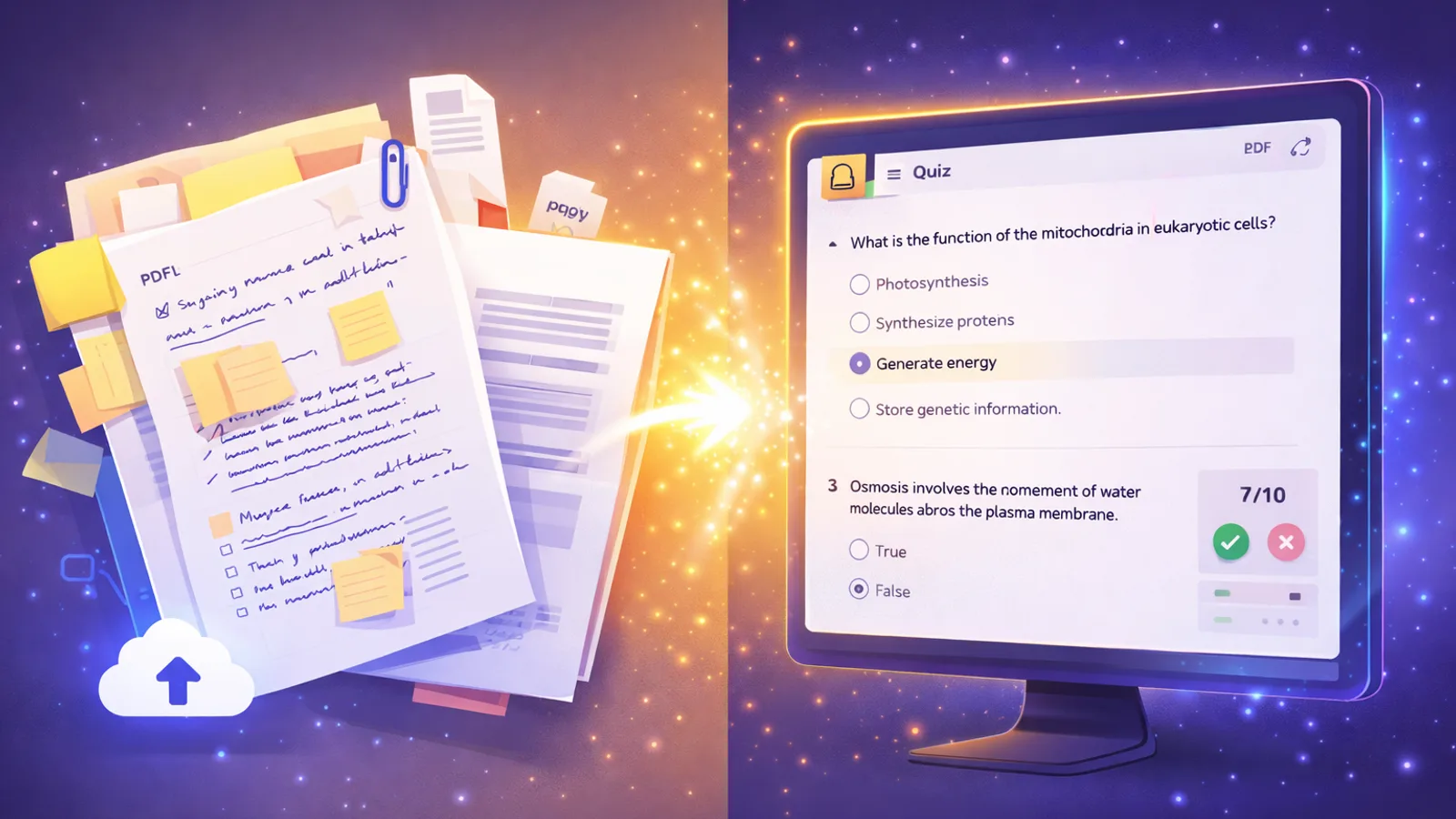
AI Quiz Generator: Create Practice Tests from Notes & PDFs (2026)
The best AI quiz generators create practice tests from your notes and PDFs in seconds. Compare top tools and learn to generate quizzes with AI.

How to Study With AI: A Step-by-Step Workflow (2026)
Learn how to study with AI in 2026. Turn PDFs and notes into flashcards, quizzes, mind maps, and summaries in minutes.